Data Entry and Transfer
Move information between applications, spreadsheets, databases, and business systems without repeatedly entering the same data.
Custom Software Development
Reduce repetitive work. Make your existing systems do more.
Manual data entry, recurring reports, quote preparation, and routine administrative tasks can consume time and introduce errors. Datericorp helps businesses identify these bottlenecks and develop automation around the software and processes they already use.
We assess the workflow, available system access, data, and business rules before recommending an approach. The solution may use APIs, scripts, database procedures, workflow tools, file processing, or custom software.
Get development support for a defined automation project or ongoing improvements, without hiring a permanent, full-time developer.
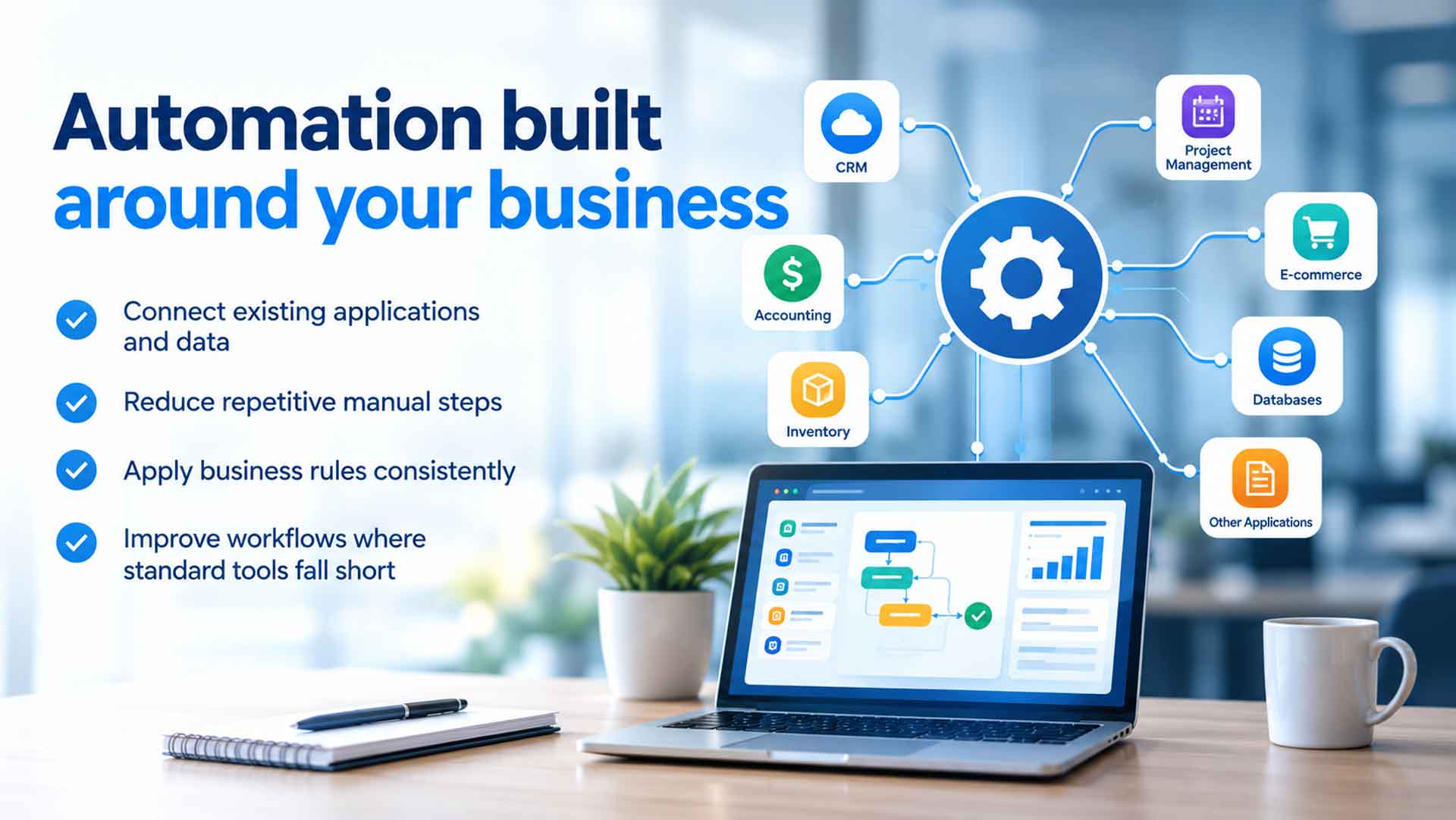
Where Automation Helps
Automation can be applied to individual tasks or to a larger workflow spanning several applications. The right approach depends on the process, the systems involved, and the rules the business needs to follow.
Move information between applications, spreadsheets, databases, and business systems without repeatedly entering the same data.
Automate recurring reports, consolidate information from multiple sources, and prepare data for business decisions.
Automate calculations, gather information from existing systems, and streamline quote preparation.
Automate routine document processing, notifications, approvals, and task assignments.
Automate repetitive steps in order handling, record updates, and related business operations.
Identify manual steps in current processes and develop custom automation where standard software falls short.
Ways to Automate
A project may use one method or combine several. Datericorp evaluates the available options before selecting an implementation.
Connect applications through their APIs to retrieve, transform, and exchange information automatically.
Example: Send new order details to accounting and update inventory when a sale occurs.
Run custom programs on a schedule or when a condition is met to process records, perform calculations, and generate outputs.
Example: Import daily sales data and prepare a management report overnight.
Use automation platforms to coordinate actions, conditions, notifications, and approvals across supported applications.
Example: Create a follow-up task and notify a manager when a customer record is added.
Process data where it is stored by validating records, combining tables, calculating values, and preparing reporting data.
Example: Calculate inventory discrepancies for a daily operations report.
Read, validate, transform, and generate formats such as CSV, XML, and JSON, with automated file transfers where supported.
Example: Process a nightly transaction export from an older accounting system.
Extract information from documents and forms using direct file parsing, templates, OCR, or AI-based extraction when appropriate.
Example: Extract invoice details and validate totals before preparing accounting entries.
Build a focused tool that combines business data, applies calculations and rules, and coordinates steps that standard software does not handle.
Example: Prepare estimates using current product costs, labor rates, and pricing rules.
Automate repetitive actions through an application's visible interface when direct integration options are not available. This is often called robotic process automation, or RPA.
Example: Enter approved information into a legacy application that has no usable API.
Matching Methods to Work
API integrations, file processing, database operations, and workflow tools can move information between systems and reduce duplicate entry.
Database queries, scheduled scripts, API connections, and automated report generation can consolidate data and prepare recurring reports.
Custom applications, API connections, database queries, and business-rule calculations can gather costs and requirements and help prepare consistent quotes.
Workflow tools, document extraction, scripts, notifications, and approval steps can coordinate routine administrative work.
API integrations, database operations, background jobs, and file exchange can automate order updates and routine record handling.
A combination of methods can address manual steps that remain because standard software lacks a required feature or does not fit the existing process.
Our Approach
Automation should fit the way your business operates, not force you to replace software that already serves a purpose.
We identify the applications involved, the information that needs to move, the manual steps, and the business rules that govern the workflow.
We review API access, data formats, database access, security requirements, exceptions, and reliability needs before recommending an implementation.
We scope the work and build the appropriate integration, script, workflow, or custom application around the requirements.
We test expected behavior and error handling, then discuss deployment and any ongoing maintenance or improvements required.
Tell Datericorp which process takes too much manual effort, which systems are involved, and what you want to improve. We can assess the requirements and discuss a practical development approach.
Discuss an Automation Project


